The sudden collapse of the Islamic Republic of Afghanistan in August 2021 is frequently diagnosed as an unexpected military failure. However, an examination of the state’s internal administrative mechanics reveals a different reality: the collapse was an institutional failure driven by calculated, day-to-day choices made behind the heavily fortified walls of the presidential palace, the Arg. For observers accustomed to Western democracies characterized by robust checks, balances, and a clear separation of powers, the structural reality of the Afghanistan model is difficult to fathom. The disaster was rooted in a hyper-centralized governance architecture that concentrated absolute executive, financial, and administrative authority within a single office in Kabul, operating more like an old-world monarchy than a modern democratic executive.
Under this framework, no decision of substance from provincial school budgets to local police logistics could be executed without the president’s personal signature. This extreme centralization hollowed out the vital checks and balances necessary to sustain a functional republic. The entire democratic apparatus, including elections, ministries, statutory councils, and the judiciary, was downgraded to an instrument of executive preservation, manipulated to ensure the political survival of the inner circle.
As an advisor in the peace process with the Taliban, I have observed how the President Mohammed Ashraf Ghani’s governance style and centralized model of governance has led us to a failure. As peace negotiations advanced and foreign forces prepared to withdraw, Ghani recognized that a genuine political transition would leave no viable role for his administration. By ultimately fleeing the country in secret, Ghani played a final card that shattered the peace process, offering global diplomacy a definitive case study in how centralization can destroy a state’s capacity to negotiate.
The collapse was a slow-motion wreck engineered through years of palace isolation, administrative bottlenecking, and missed diplomatic windows. The theoretical roadmap for this centralization trap was published long before Ghani ascended to power. In May 2008, Ghani co-authored Fixing Failed States, a text that established him as a premier intellectual within Western institutional circles. In this work, Ghani laid out a rigid, top-down blueprint for governance, viewing state-building not as a dynamic political negotiation among domestic factions, but as a technical, purely managerial task. He introduced the concept of the state as a manager of ten core functions to bridge the “sovereignty gap,” arguing that a centralized executive framework must tightly control these operations. Under this textbook philosophy, informal traditional networks, local tribal councils, and regional powerbrokers were viewed as obstacles to be systematically overridden by hierarchical decrees from the capital city. This rigid philosophy later defined his entire leadership style, treating a crisis-ridden warring nation like an organized private classroom.
This ideal found validation in April 2013, when Great Britain’s Prospect magazine named Ghani the runner-up for World’s Top Thinker. His 2014 presidential campaign relied heavily on this title to market him to Western donors and the electorate as an unassailable genius who could solve complex problems purely through intellect. Relying on a constitution that granted him near-monarchical status, Ghani believed that top-down administrative decrees from within the Arg could easily overshadow complex socio-political networks and regional realities. The combination of these factors created a fatal vulnerability: a leadership isolated within the palace echo chamber. This insulation guaranteed that severe administrative bottlenecks and missed diplomatic windows would ultimately define the state’s terminal response when systemic crises arose.
The Bitter National Unity Government Deal
Following a highly disputed presidential runoff plagued by massive fraud and systematic engineering, Afghanistan faced a political breakdown. On September 21, 2014, under intense diplomatic pressure from U.S. Secretary of State John Kerry, a 50/50 power-sharing deal was struck between the two competing camps to prevent an immediate collapse. Under this framework, Ghani assumed the presidency, while Dr. Abdullah Abdullah, former minister of foreign affairs and a key Tajik front-runner, assumed the newly created role of Chief Executive Officer (CEO).
Crucially, this arrangement was not an appointment by Ghani, but an equal political compromise forced by a deeply compromised election. Rather than fostering institutional cooperation, this mandatory 50/50 split institutionalized deep dysfunction from day one, as the palace fiercely resisted sharing appointments, resources, and constitutional authority with the CEO’s office.
While Washington shifted toward exit diplomacy in 2018, the palace focused inward to secure operational leverage over the state’s voting mechanics. The Independent Election Commission (IEC) evaluated applicants through rigorous competitive examinations. To guarantee control over this election, Ghani systematically undermined the neutrality of the commission framework. When the commission officially recommended a legal shortlist of three qualified candidates to serve as the Head of the Secretariat of the IEC, Ghani flatly rejected the entire shortlist. This micromanagement ensured the vital administrative seat remained strategically empty for months until the palace could secure operational leverage over the mechanics of the upcoming vote.
Following years of a costly military stalemate, U.S. foreign policy underwent a permanent transition. Washington shifted away from an endless counter-insurgency war against the Taliban to focus its resources on strategic competition with major global powers like China and Russia. Realizing a military victory was impossible, the United States bypassed the government of Afghanistan entirely to initiate direct, unilateral peace talks with the Taliban in Doha, Qatar. Ambassador Zalmay Khalilzad was appointed to lead this reconciliation process, sending an undeniable signal that Washington’s patience had run out.
Despite warnings from the United States and international allies to postpone the 2019 presidential vote and focus entirely on the accelerating peace track, Ghani insisted on holding the election. The U.S. Embassy in Kabul, led by Ambassador John Bass, repeatedly warned that a rushed, expensive election would fracture national unity and ruin early peace initiatives with the insurgency. When international donors refused to finance the race, Ghani unilaterally ordered over ninety million dollars to be taken directly out of Afghanistan’s national budget, draining vital infrastructure funds to bankroll his campaign.
The resulting election was deeply flawed, severely compromised by widespread irregularities, ballot stuffing, and system manipulation. This blatant corruption destroyed the public’s motivation to participate, resulting in the lowest voter turnout in the history of Afghanistan. A government emerging from such a fundamentally fraudulent election carried a severely damaged mandate, having won the votes of less than ten percent of eligible voters.
The Downgrade in U.S. Relations and the Doha Agreement
Immediately after the controversial election results, John Bass, the U.S. Ambassador, concluded his tour of duty in Kabul. Signaling a permanent downgrade in bilateral relations, the United States never appointed another full, Senate-confirmed Ambassador to Afghanistan for the remainder of the Republic’s existence, choosing to leave the embassy under temporary leadership instead. Shortly after, the United States and the Taliban signed the historic Doha Agreement on February 29, 2020. The accord laid out a strict timeline trading the total withdrawal of American and NATO military forces for Taliban counter-terrorism guarantees and a promise to enter direct negotiations with the government of Afghanistan.
The internal political crisis exploded into open theater on March 9, 2020. Abdullah and his supporters firmly believed they were the true winners of the 2019 presidential race, viewing the official results as the product of gross electoral fraud and political engineering. In an unprecedented display that stunned international observers, two competing presidential inauguration ceremonies were held simultaneously in Kabul—Ghani at the Arg and Abdullah at the Sapedar Palace—effectively splitting the sovereign state in half just as the American withdrawal clock began to tick.
To resolve this dangerous deadlock, the United States stepped in with intensive diplomatic support, pushing both sides toward a compromise to safeguard the enormous international investment in the country. This effort resulted in a second major 50/50 power-sharing agreement signed in May 2020. This political compromise formally established Abdullah as the head of the newly created High Council for National Reconciliation (HCNR) to lead the national peace track. Like the CEO position before it, this was a forced partnership born of electoral deadlock, not a top-down presidential appointment by Ghani.
Direct negotiations with the Taliban were mandated to begin on March 10, 2020, immediately following the political compromise. Instead, Ghani violated the spirit of the deal. Using his hyper-centralized authority, the president held up peace deadlines for personal gain, dragging his feet on appointing the government’s negotiating team for six months. He stalled prisoner releases and delayed meetings, demanding that domestic rivals and international partners formally treat his presidency as the sole authority before allowing the HCNR to function. By the time talks finally started in September 2020, six months of critical diplomatic momentum had vanished.
During the initial rounds of the Doha talks, Ghani deliberately stalled negotiations in anticipation of the 2020 U.S. presidential election. Believing a change in the White House would reverse the American decision to leave, the palace wasted critical months. This foot-dragging was driven by a specific partisan assumption inside the Arg: Ghani was convinced that if the Democrats won the election, the incoming Biden administration would discard the transactional approach and completely rewrite U.S. strategy. Palace insiders believed that a Democratic White House would view the preservation of the Republic, women’s rights, and democratic institutions as non-negotiable, choosing to maintain a conditions-based military presence rather than proceeding with a rapid, unconditional withdrawal. The palace assumed that a Democratic administration would neutralize the Doha framework and return leverage to Kabul.
When the administration did change in Washington, Ghani shifted his energy toward a fierce, backchannel diplomatic campaign to rip up the Doha Accord. This proved to be a catastrophic miscalculation. Rather than reversing course, the incoming Biden administration prioritized the domestic mandate to end America’s longest war. Crucially, the Biden administration decided to keep the core parameters of the Doha Agreement intact and made the deliberate choice to retain Ambassador Khalilzad as the lead envoy to ensure diplomatic continuity. By backing the existing withdrawal framework and keeping the same appointee in place, Washington shattered the palace’s partisan illusion, leaving an uncalibrated and isolated Kabul government entirely unprepared for the rapidly ticking clock.
The Unconditional Timeline Set
The clock accelerated rapidly when the Biden administration reviewed the withdrawal architecture. On April 14, 2021, Washington announced that the final, unconditional withdrawal deadline for all remaining American forces would be firmly set for August 31, 2021. This announcement shattered the palace’s core gamble that U.S. troops would stay indefinitely.
The escalating frustration of American backers became public in March 2021, when a stern, confidential letter from U.S. Secretary of State Antony Blinken to President Ghani was leaked to the press. The letter bluntly warned Ghani that the military situation on the ground was rapidly deteriorating and urgently demanded that Kabul stop obstructing the peace roadmap. Simultaneously, the letter exposed that Ghani’s National Security Advisor, Hamdullah Mohib, had been secretly trying to run separate, uncoordinated backchannel negotiations behind the backs of the Republic’s own designated peace council and negotiating team.
Sabotaging the Istanbul Conference and the Kabul University Lecture
The international community made a final push to rescue the peace track by organizing a high-level summit in Istanbul, Turkey, to broker a transitional power-sharing government in April. Ghani actively worked to derail the summit. When the High Council for National Reconciliation drafted a comprehensive, unified national peace plan reflecting consensus across the country’s political spectrum, Ghani used his executive veto to cancel it, replacing it with a vague, two-page palace graphic.
Instead of genuinely engaging with the geopolitical realities on the ground, Ghani turned to academic platforms to present an illusion of control. He held a highly publicized lecture at Kabul University, standing before academics and students to detail his own “peace plan”—a top-down blueprint focused on rigid legalistic steps and eventual early elections. This presentation displayed a profound disconnect from reality; Ghani behaved like an unassailable political science professor while the country’s districts were physically falling around him. To seal the diplomatic deadlock, Ghani publicly declared he would only attend the Istanbul summit if the reclusive top leader of the Taliban, Mullah Haibatullah Akhundzada, came in person. Tying his presence to an impossible condition successfully shifted the public blame onto the insurgency, forcing Turkey to postpone and ultimately suspend the conference, destroying the last real platform for a structured transition.
Internal Lockout and Media Propaganda
As U.S. forces rapidly closed down their logistics bases and handed over major airfields, prominent senior political and regional leaders of Afghanistan tried to bypass the palace blockade by forming a high-level Supreme State Council to make rapid decisions on national defense and survival in June 2021. Ghani repeatedly blocked the war cabinet to protect his unchecked executive authority. To maintain a false appearance of inclusivity while actively shutting out domestic political heavyweights, the palace relied heavily on highly choreographed media optics.
A prominent statesman and former Vice President, Yunis Qanuni, later exposed the inner mechanics of this deception, detailing how Ghani systematically used national unity as an empty public relations tool. In a sharp assessment delivered in August 2021, Qanuni stated:
“Ghani used to collect the top leaders in the Arg just to take photos and publish them in the media to claim he consulted with the leaders. But the photos were from us, while the words were entirely from him.”
Through this orchestrated public relations strategy, the palace broadcast images of consensus to the international community, masking an isolated regime that disregarded the input of the country’s political factions. At the same time, Qatar’s Special Envoy, Dr. Al-Qahtani, secured an agreement to send a top-tier team of leaders from Afghanistan to Doha to finalize an emergency political deal. Ghani sabotaged the effort by vetoing key delegates and stripping the team of all decision-making power.
The Aborted Last-Minute Doha Push
As the Taliban rapidly captured major provincial capitals and advanced directly toward Kabul, a final, desperate diplomatic rescue mission was mounted. A high-level political meeting took place in Kabul where Abdullah and former President Hamid Karzai met directly with President Ghani. They proposed a plan to fly a high-level national delegation of fifteen leaders to Doha the next day to finalize an emergency power-sharing deal and secure a political settlement that would halt the insurgent advance outside the capital.
However, Ghani stubbornly refused to endorse the arrangement or delegate real authority to the team. By withholding his institutional approval, Ghani scuttled this final diplomatic effort to stall the takeover, effectively dooming the last opportunity for an organized ceasefire.
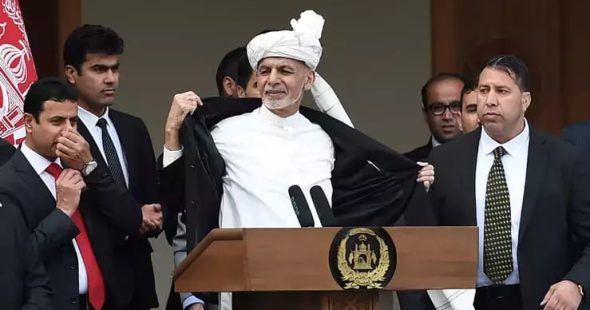
With the capital surrounded and the security architecture paralyzed by top-down micromanagement, Ghani played his final card. Rather than coordinating a transition with the defense leadership or his peace council, Ghani fled the country in secret on a helicopter. His sudden departure created an instantaneous security vacuum, triggering the chaotic release of thousands of high-risk prisoners from Bagram and Pul-e-Charkhi, and bringing a catastrophic end to twenty years of state-building efforts.
The Long-Term Cost of Inaction: The View from June 2026
The devastating trajectory set in motion by the palace’s refusal to compromise reaches its full, tragic expression in the mid-2020s. By June 2026, the educational catastrophe has fundamentally locked in. United Nations agencies, including UNICEF and UNESCO, confirm that Afghanistan marks its fifth consecutive academic year where girls above the sixth grade are strictly barred from classrooms. Over 2.2 million adolescent girls are actively denied secondary education.
The direct line from the palace’s tactical political sabotage in 2020 and 2021 to the realities of June 2026 reveals a nation stripped of its future institutional capacity. Because the collapse of the state left the country under an unconstrained, unmediated system, the critical human capital required to sustain basic social systems is dying out. UNICEF projects that the continuous ban on female education will generate a critical deficit of over 25,000 trained female professionals—specifically teachers and healthcare workers—by 2030, a shortage that is already triggering catastrophic spikes in maternal and infant mortality rates. The complete exclusion of half the population from the skilled workforce has severely damaged national recovery, cementing systemic poverty directly as a consequence of the strategic vacuum created in August 2021.
Constitutional Defense or Political Obstruction?
To truly understand why this trajectory was so fatal, one must examine the baseline decisions of the executive leadership. Even if we entirely remove external combat dynamics from the equation to focus strictly on Ghani’s executive choices, the historical record highlights a fundamental failure of statecraft: the refusal to calibrate political strategy to match objective reality. The inescapable reality of mid-2021 was that the U.S. was fully withdrawing, the international community was completely exhausted by twenty years of war, and global partners unyieldingly demanded a transition to peace rather than an escalation of a broken conflict. Time was rapidly running out, and the international consensus had fundamentally shifted toward a political settlement.
Faced with this clear paradigm, Ghani had two legitimate paths available to him as a statesman. He could have chosen a path of structured cooperation, working hand-in-hand with his international backers and domestic partners to engineer an organized, conditional transition of power that preserved the Republic’s institutions. Alternatively, if he was truly determined to protect the Republic’s sovereignty at all costs, he could have forged a fiercely independent domestic path, mobilizing local factions and taking personal, unyielding ownership of the defense of Kabul.
Instead of choosing either viable path, Ghani took a third, catastrophic route: he chose to sabotage diplomacy while failing to prepare for the reality of withdrawal. He blocked international mediators, dismantled domestic consensus at Istanbul, and insulated himself in a palace echo chamber, all while fully depending on the very foreign aid he was actively insulting.
The Devaluation of Democratic Pillars
Under this flawed approach, Ghani effectively downgraded the entire democratic process to an instrument of executive whim. Because the constitutional structure concentrated near-monarchical power in the Arg, elections were not treated as sacred transitions of public will, but rather as performances to secure operational mandates for his inner circle. Ministries were hollowed out into administrative bottlenecks, and statutory bodies like the HCNR were systematically bypassed. By micro-managing electoral appointments and using state assets to bankroll highly disputed political outcomes, Ghani degraded democratic structures into cosmetic props. He wanted the aesthetic of a republic, but rejected the functional reality of an institutional democracy.
Constitutional legitimacy cannot exist in a vacuum devoid of domestic support, and a government cannot claim a legitimate democratic mandate when its own rushed election was structurally fraudulent and resulted in less than ten percent turnout among eligible voters. By prioritizing an empty textbook title over political reality, Ghani actively paralyzed the state’s leverage.
Palace apologists often frame Ghani’s unyielding stance as a principled refusal to capitulate to an insurgency that they claim had no intention of honoring agreements or preserving human rights. However, looking at the objective aftermath of his escape completely invalidates this defense. By fleeing the capital in secret, Ghani handed the Taliban uncontested ownership of the state apparatus, its institutions, and a vast arsenal of military hardware without a shred of constitutional or legal constraint. His stubborn refusal to compromise did not block a Taliban takeover; it mathematically guaranteed it.
Had Ghani engaged in a structured political compromise and a managed transition of power, Afghanistan would undoubtedly be in a far better position today. A transition brokered with international endorsement would have integrated verification mechanisms and bound the incoming authority to explicit diplomatic obligations. Within a joint transition framework backed by regional and global leverage, international mechanisms to protect fundamental civil liberties—such as keeping schools open for all girls—would have retained active diplomatic traction. Instead, Ghani’s political obstruction and chaotic flight left the nation entirely at the mercy of an unconstrained authority, leaving millions of women and girls to bear the heavy cost of educational erasure.
While the U.S. military withdrawal undoubtedly shattered frontline morale, it was the hyper-centralized structure of the palace command that systematically broke the army’s back. Because the presidency wielded the unchecked authority of a king, the palace directly micromanaged logistical operations, fuel supplies, and senior military appointments based on personal loyalty rather than battlefield competence. By stripping regional commanders of basic decision-making power, the centralized architecture ensured that when the frontlines faced an existential crisis, the entire apparatus froze.
Ultimately, the immediate chaos generated by his exit highlights the cost of this isolation. By abandoning the capital in absolute secrecy, without coordinating a transition with his own peace council or defense leadership, Ghani created an instantaneous security vacuum. This sudden flight shattered any remaining administrative apparatus and forced the uncoordinated, chaotic release of thousands of dangerous prisoners. He did not go down fighting for his independent path, nor did he stick around to fulfill his duty to transition power safely. His departure single-handedly destroyed the final, U.S.-brokered opportunity for an organized, dignified transitional power-sharing agreement that could have preserved the Republic’s institutions and protected civil rights.
Conclusion and Lessons Learned
The political tenure of Ashraf Ghani demonstrated that an executive who refuses to compromise institutional authority for the broader preservation of the state will ultimately sacrifice both. Had the palace prioritized statehood over personal survival during the critical windows of 2020 and 2021—by engaging in a managed, UN-supported transition and accepting third-party mediation—the state could have engineered an orderly, verified transfer of authority that retained international diplomatic leverage. Because the leadership chose systemic obstruction, the Republic collapsed completely from within, leaving the population to inherit the severe, generational realities of institutional erasure, deep poverty, and geopolitical isolation.
The Critical Imperative of Institutional Reform
The fundamental baseline of constitutional statecraft dictates that institutional design outweighs individual leadership. If a state fails to reform, balance, and decentralize its core statutory frameworks from the outset, an executive office can easily assume near-monarchical authority. When institutions lack meaningful accountability, the executive naturally reduces the democratic framework to a cosmetic instrument. Rather than staging elections as political performances designed to retain an inner circle’s monopoly on power, a resilient state must actively consult, integrate, and defer to its domestic population, generating systemic legitimacy from the ground up.
The Futility of Ad-Hoc Constitutional Patchwork
The persistent necessity for U.S. support—specifically in facilitating the forced 50/50 power-sharing arrangements of the Chief Executive Officer (CEO) position in 2014 and the High Council for National Reconciliation (HCNR) in 2020—serves as empirical proof that Washington recognized the fatal danger of Afghanistan’s hyper-centralized bottleneck. This critical U.S. support was directly tied to American national security and aimed at resolving systemic gridlock to protect the immense investments of international blood and treasure.
However, because these power-sharing frameworks were implemented as temporary, crisis-driven political compromises following engineered and fraudulent elections, rather than permanent structural reforms, they failed to correct the core institutional pathology. Consequently, the bilateral relationship between the U.S. and both presidents of Afghanistan (Hamid Karzai and Ashraf Ghani) soured dramatically over time. Enabled by near-monarchical constitutional authority, the palace consistently resisted true accountability, sidelined parallel stabilization efforts, and prioritized narrow executive survival over the long-term strategic and national security objectives of its primary international benefactor.
The Primacy of Domestic Political Cohesion
A sovereign government cannot credibly negotiate strategic compromises with an armed adversary while actively marginalizing its internal political stakeholders and bypassing its designated reconciliation bodies. Internal political synergy represents a state’s primary currency at the negotiating table; fracturing this consensus hollows out the regime’s structural leverage long before foreign military support ceases.
The Inflexibility of Global Strategic Timelines
Peripheral states must realign their political timelines with the macro-level strategic imperatives of their primary international backers. Stalling tactics implemented by local political actors are fundamentally incapable of halting the logistical or military withdrawal calendars of a global superpower once its broader geopolitical priorities shift toward major power competition.
The Necessity of External Third-Party Mediation
Highly complex, identity-driven intra-state conflicts cannot be successfully arbitrated through unmediated, direct negotiations between historic adversaries. Robust international mediation frameworks are structurally required to guarantee verification mechanisms, provide neutral ground, hold conflicting factions to reciprocal benchmarks, and dissolve systemic deadlocks before state structures atrophy.
References
- The Cairo Review of Global Affairs. (2018). “Prioritizing Peace Ahead of Economic Growth.” [Geneva Conference Strategic Roadmap Analysis].
- Salam Watandar Archive. (May 2018). “Why is Amarkhail’s seat still empty?”.
- Independent Election Commission (IEC) Internal Archive. (May 2018). Shortlist Nominations for the Position of Head of the Secretariat of the IEC and Executive Delay Records by the Palace. Kabul, Afghanistan.
- Azimi, Abdul Basir. (2024). “Ashraf Ghani’s Unscrupulous Bid to Regain Old Power in Afghanistan.” Fair Observer. [Online Archive].
- S. Embassy Kabul / Ambassador John Bass. (2019). Official Diplomatic Briefings and Statements Regarding the Postponement of the Presidential Election and Peace Process Sequencing. Kabul, Afghanistan [Public Domain / VOA Archive Records].
- Eurasia Review. (March 2021). “A Blunt Letter From US Secretary Blinken To the President of Afghanistan, Ashraf Ghani – Analysis.” Political Analysis Briefing Group.
- Responsible Statecraft. (March 2021). “Blinken to president: play ball or get out of way.” Cato / Quincy Institute Analysis Frameworks.
- S. Department of State / Office of the Historian. (2020). Chiefs of Mission for Afghanistan: Institutional Records on the Transition to Chargé d’Affaires ad interim status following January 2020. Washington, D.C.
- House Oversight Committee. (August 2021). “Official Correspondence to Secretary Blinken Regarding President Ghani’s Sudden Flight and Capital Embezzlement Reviews.” U.S. House of Representatives Institutional Archive.
- Voice of America (VOA) News. (March 2021). “Blinken Warns Ghani of Dire Consequences Without Urgent Changes.” South and Central Asia Bureau Records.
- UNICEF Press Centre. (April 2026). “Restrictions on girls’ education and women’s employment in Afghanistan could lead to a loss of over 25,000 female teachers and health workers by 2030.” UN Children’s Fund Global Communications Bureau.
- UNICEF USA Policy Updates. (May 2026). “By Restricting Girls’ Education, Afghanistan Faces Future With Fewer Teachers, Health Workers.” UNICEF Innocenti Research Centre Briefings.
- UNESCO Knowledge Portal. (January 2026). “UNESCO and UNICEF urge action to protect the right to education in Afghanistan.” UN Joint Country Team Operations.
- Blinken, Antony J. (March 2021). “Official Secretarial Correspondence Transmitted to Kabul Security Elements.” Project on Defense Alternatives Information Repository.
- The New Arab. (August 2021). “Taliban meet with Karzai and Abdullah, Ghani backs talks.” Global Policy Dispatches.
- TRT World News. (December 2021). “Karzai ‘invited’ Taliban to Kabul after Ghani fled in secret.” Asia-Pacific Diplomatic Frameworks.
- Council on Foreign Relations (CFR). (2021). “The U.S. War in Afghanistan: 1999–2021 Timeline Archive.” Center for Preventive Action Statecraft Repositories.
- Parwan University Press Portal. (May 2021). “Participate in the online conference (peace building) by President Mohammed Ashraf Ghani presented at Kabul University.” Ministry of Higher Education Research Repositories.
