My friend Omar Sharifi has written an essay that deserves slow reading and calm debate. In “On Exile, Moral Reckoning, and Afghanistan’s Cosmopolitan Elite,”¹ he holds up a mirror to those of us who grew up, served, fought, and advocated for a free and democratic state during the republic’s twenty years. I accept his mirror. I want to hold it from the other side of the aisle, that is, from inside the government where I served.
I welcome this overdue call for reckoning, and value that it comes from within Afghanistan’s intelligentsia. From the political side, however, where most of the responsibility lies, little has come out in the five years since the fall. To my knowledge, none of the three men, Hamid Karzai, Abdullah Abdullah and Ashraf Ghani, who led the republic in its final decade, has written his own account. The few memoirs by former republican ministers, advisers and military commanders nearly all follow one pattern: the author is cleared, and the fault lies with rivals, with foreigners or with the president’s circle. One senior official who visited Ashraf Ghani, the former president in exile, recounts in his memoir that he found no visible regret, only blame for everyone but himself and his closest aide.² In private, the picture is different. Among second- and third-tier officials, I hear confessions, not so much for what they did as for why they chose to serve at all.
This essay is therefore a call to both sides of the aisle, to those who served in the state and those who built civil society around it. I write it knowing the risk. A former official who describes his own record can easily sound like one more author clearing himself, and parts of what follows may read that way. That is not my aim. I accept my share of the blame, as a deputy minister, as a diplomat and as someone who wrote and spoke for the state he served. I was not silent then, and I have not been silent since the fall. I have been resisting and reflecting on my own record, failures and shortcomings at the same time. The two, I believe, belong together.
Before turning to the government side, I want to settle three preliminary questions: why reckoning matters now, what kind of mistakes, complacency, and even guilt we are speaking of, and by what yardstick it should be measured.
The necessity of reckoning
Past, present and future lie on a single continuum. As Ibn Khaldun observed in the Muqaddimah, “the past resembles the future more than one drop of water resembles another.”³ In the opening pages of Kherad-e Āvāreh (Wandering Reason), our own scholar Ali Amiri takes this insight a step further.⁴ The difficulties of the present, he argues, “undoubtedly have their roots in the past,” but the link between them is not mechanical. What connects one period to the next, and gives each its shape, is thought; where thought is absent, history breaks down into rupture. The present is not a fate handed down by the past but the result of how we have thought and failed to think.
That is why a critical review of the past is the precondition for a better future. Only by tracing how our ideas and institutions led to collapse can we avoid repeating the same failures. Amiri also warns that many intellectuals present the current state as normal, because treating catastrophe as normal costs less than admitting it.⁵ Our political narratives long took the same easy path, blaming the British Empire and Soviet Russia then, or the United States and Pakistan now (which does not mean these players are blameless), and avoiding accountability at home. Moving beyond requires asking which internal political, institutional and social conditions made our failures possible.
But a reckoning also needs clarity about what kind of responsibility is at stake. Without it, the conversation dissolves either into blame or into a vague remorse that names no one.
But we must not, as in the past, cultivate victimhood, or a false sense of pride in being things that we are not, for example, the so-called graveyard of empires, while waiting for salvation from outside. The seeds sown over twenty years run deeper than the image of barren soil suggests.
What kind of guilt and responsibility
In 1946, the German philosopher Karl Jaspers faced the same question about his own country in The Question of German Guilt.⁶ He distinguished four kinds. Criminal guilt is a breach of law, judged by courts. Political guilt falls on those who shared in the state and must bear the consequences of its deeds. Moral guilt concerns what each person did or failed to do, and its judge is one’s own conscience. Metaphysical guilt is the failure of solidarity with those who suffered, a matter between each person and God. Jaspers rejected collective guilt in the criminal or moral sense, since a whole people cannot be a criminal. But political liability, he insisted, is shared by all who held a part of the state.
This distinction closes two easy exits. The first is the claim that everyone is guilty and therefore no one is, where “we” becomes a hiding place. The second is the scapegoat: a few top leaders made to carry the burden of failures so that the rest of us can feel clean. By Jaspers’ measure, I carry political guilt as a senior official of a state that collapsed, and I owe a moral account of my own acts and silences. I do not claim to have settled that account. I claim only that it is mine to settle, and that I intend to.
The diagnostic yardstick
Sharifi draws on Goffman, Butler and Pandolfi to show how dependent the elite became on foreign frameworks, and he is right.⁷ Yet his own method makes a further point: he uses Western thinkers to diagnose the problem. Borrowing ideas from the West is not itself the failure, so our reckoning need not turn against modernity.
To judge the post-2001 Afghanistan third republican era fairly, we must avoid two reductive narratives that I often hear from both local and international critics of the republic. The first is total systemic nihilism, which holds that every institution, NGO, urban center and reform effort was futile, corrupt or misplaced, and that the soil of Afghanistan was simply barren for the seeds of democracy. The second is rural and tribal romanticism, which portrays the countryside as morally pure and institutionally sound, and therefore, being endogenously rooted, more legitimate. Nor should reckoning simply invert the old binary of “good and bad Afghans,” as Sharifi puts it, turning yesterday’s spoilers into today’s heroes.
The modern state, popular sovereignty, democracy, human rights and civic values were not the real causes of our failure. The cause, rather, lay in our flawed understanding, biased adaptation, and weak execution of them, and equally in our fragile sense of personal agency and collective ownership of the state.
I therefore propose grounding our reckoning, and our future political frameworks, in a realistic standard built on two principles. First, aligning universal principles, such as the Universal Declaration of Human Rights, popular sovereignty and democracy, with our own Islamic and civilizational intellectual traditions. Second, evaluating the support of our international partners objectively, acknowledging both its positive and negative effects over two decades of intervention in Afghanistan while recognising that foreign powers ultimately act out of their national self-interest. Future reform cannot rest on a mentality of foreign rescue or perpetual grievance.
Sharifi’s own metaphor helps show what this failure of ownership looked like.
The stage and the script
Sharifi’s analogy of the stage and the performance is apt, but the deeper question is the script. Did we learn it, internalise it, own it? Even the cosmopolitan elite he describes seems not to have.
Yet we did have a text that was ours. The 2004 constitution was debated and adopted by a constitutional assembly (Constitutional Jirga) and, despite all its challenges and contradictions, remained the best available framework for a free society and democratic state. Our failure was twofold: we did not live by it, and we did not address the parts that needed amendment. Even its drafters expected it to be reviewed within ten years. The gap between its bill of rights and the concentrated power of the executive was visible early.⁸ The clearest proof came in 2014, when the National Unity Government created institutions that the constitution did not provide for. That arrangement was an admission that the text needed revision. Its own promise of a constitutional assembly to amend the constitution was never kept,9 and we patched where we should have reformed. This is a major part of our reckoning, and responsibility for it lies with the political class, including those of us who served inside it.
Resistance and self-examination should go hand in hand, as one without the other could be either self-righteous or paralyzed.
By the second decade of the republic, as we learned to write policy and argue with our international friends, we found ourselves caught between two other scripts and a violent conflict. One was the international script of liberal democracy and human rights, the product of at least two centuries of deliberation in its birthplace in Europe and America. The other was the Taliban’s extremist, medieval and tribal script. Between them, our own text, the constitution, was too often treated as a formality rather than a covenant.
A script that was not owned, only performed, was not defended. When the test came, and the Taliban arrived at the gates of Kabul, too few of those who had performed it were willing to stand by it, and a few even joined the opposite side.
Between our making and our fate
We were at war. A violent conflict raged throughout those years, and the forces arrayed against the Republic were not only domestic. Pakistan’s sanctuary for the Taliban, regional rivalries and the shifting interests of great powers were real. So was the decision of the United States to negotiate directly with the Taliban, sidelining the republic. To deny all this would be a reductionism of its own.
But we were not passive onlookers. Even at war, we had a role and a stake: in how we governed, how we distributed power, how we contested elections, how we fought and how we spoke for ourselves at the table. The mishandled 2014 election was ours. So was the failure to build a political consensus strong enough to survive the withdrawal of our international partners. A serious reckoning must ask, case by case, how much was of our making and how much was truly out of our hands. Only then can we stop hiding behind geopolitics and stop pretending it did not exist.
Taking agency
That question has to be answered by people, not abstractions, and the first answers are owed from the top. External constraints on the political leaders and on all of us inside the government were substantial and often suffocating, but a true reckoning requires our political leaders to claim full agency for their own failures. That applies above all to the three top leaders, each of whom must confront his own role in the collapse. Unfortunately, in our political culture, top-tier leaders rarely analyze their own tenure, admit fault or apologize publicly. Breaking this habit is essential for any genuine national reckoning.
If the first tier remains unwilling, as it seems to be so far, the self-critical dialogue must begin among second- and third-tier officials ready to break the silence. I count myself among them, and I will not ask of others what I do not ask of myself. These are the questions I shall put to my own record. Did I say in public what I said in private about the state’s weaknesses? Did I speak early and loudly enough after the 2014 fiasco, and when the republic was pushed aside in the peace process? As a diplomat, did I present the republic abroad as stronger than I knew it to be? And many other questions. I am committed to addressing these in the next part of this dialogue, and I invite colleagues from every side to answer their own.
A view from within
I describe where I stood not to excuse myself, but so the reader can judge my account against my position. I did not join this “cosmopolitan elite” from civil society or from abroad, but from the opposite direction. I was seen as connected to the anti-Taliban resistance of the late 1990s. Like many of my generation, I was internally displaced. The civil war forced me out of school in Kabul to my native village further north, in Kapisa, and the Taliban onslaught ended my first year at medical college in Balkh. I worked with the ICRC, resumed my education at Kabul University in 2002 and joined the post-Taliban foreign ministry. In that sense, I stood between the cosmopolitan elite and the former Mujahideen and resistance forces, both committed to a free and democratic Afghanistan in the past two decades and now, though from different vantage points.
From 2015 to 2019, as Deputy Foreign Minister, I spent days and nights in the villages north of Kabul, in Shamali, Parwan, Kapisa and Panjshir, with young activists. What I tried to share with them was an early sketch of what a new script should look like. Do not become performers. Do not become strangers in your own communities by speaking a language your neighbors cannot follow. Take the best and most useful of these ideas, internalize them, and speak of them in words people understand. A gathering after the Friday prayer at the mosque can be a town hall meeting. We argued that the purpose matters more than the name and what counts is a place where people come together, talk about local problems and find local solutions. Mosques, schools, universities, provincial councils, village councils and the branches of the National Solidarity Program had all, in different ways, produced a hybrid generation able to do this. Too often, we left such spaces to others, and the Taliban used them well.
But by then it was late, and what I and others did was too little. The 2014 election tarnished that generation’s faith in democratic politics. When the United States entered negotiations and the Taliban were suddenly recast from extremists into counterparts, even these young people grew doubtful. Some of that doubt we earned ourselves. Yet those years also showed me that the script could be made on our own, translated into our language and anchored in our institutions, had we found the time and the will.
A script of our own
That task now falls to us. Those inside the country live in intellectual exile, facing the Taliban’s script in full without freedom of expression, while those outside are living and learning the international script painfully and in real time. It is a tragic situation for both. Yet in our tradition, from Ibn Sina to Mawlana Balkhi-Rumi and Sayyid Jamaluddin Afghani, exile has produced the best scripts.
The task of this reckoning is making a script of our own, rooted in our past and our civilization, but fully informed by a century-long struggle inside Afghanistan, from the constitutional movement in the early twentieth century until now, for freedom, equality, popular sovereignty and a constitutional government. We will need help from our international partners backstage, with lights, sound, and costumes. The script also has room for many diverse actors, women and men, from our ethnic, religious and linguistic groups, who not only act but also argue and write. Once we are the scriptwriters, outside support is no threat.
Conclusion: the generation of the bridge
The people of Afghanistan have been victims of many invasions and narratives. But we must not, as in the past, cultivate victimhood, or a false sense of pride in being things that we are not, for example, the so-called graveyard of empires, while waiting for salvation from outside. The seeds sown over twenty years run deeper than the image of barren soil suggests. The fact that the women of Afghanistan are standing against the Taliban shows that change is coming from within. Nor have all of us in exile been waiting passively. Despite all domestic suppression and international discouragement, civil, political and defensive resistance is picking up. However, resistance and self-examination should go hand in hand, as one without the other could be either self-righteous or paralyzed.
What this moment needs is candor. In our culture, no one admits mistakes in public, least of all a political leader, because whoever confesses first becomes the scapegoat. We should accept that risk. Our generation must break this habit and take responsibility, even beyond our share, but first we must name that share. If our civic and democratic elites, at home and in exile, in government and in civil society, confront past errors without hostility or romanticism, they can build a credible, self-reliant vision for Afghanistan’s future.
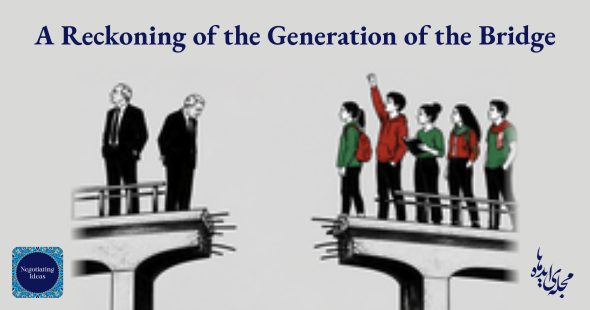
I call this a dialogue: a reckoning of what we can call the generation of the bridge, nasl-e pul. We are those who stood between the resistance and the republic, and between the state and civil society, and who can now build a bridge between our past and our future by passing honestly through our present. This is a call to my friend Omar Sharifi and to both sides of the aisle. I am ready to begin, and I will begin with myself.
Notes
- Omar Sharifi, “On Exile, Moral Reckoning, and Afghanistan’s Cosmopolitan Elite,” Negotiating Ideas Society, 2026.
- Mohammad Umer Daudzai, Uncensored: A Narrative of Afghanistan’s Collapse (Kabul: Amiri Publication, 2023); see also Khalid Payenda, interviews and post-collapse reflections on executive decision-making.
- Ibn Khaldun, The Muqaddimah: An Introduction to History, trans. Franz Rosenthal (Princeton: Princeton University Press, 1958), vol. 1,
- Ali Amiri, Kherad-e Āvāreh: Zohur va Zavāl-e ʿAqlāniyat dar Jahān-e Eslām [Wandering Reason: The Rise and Decline of Rationality in the Islamic World] (Kabul: Nashr-e Amiri, 1392/2013), 8–9. Translation mine.
- , p. 9
- Karl Jaspers, Die Schuldfrage (Heidelberg: Lambert Schneider, 1946); in English as The Question of German Guilt, trans. E. B. Ashton (New York: Dial Press, 1947).
- Sharifi, “On Exile, Moral Reckoning.” He draws on Erving Goffman, The Presentation of Self in Everyday Life (1959), Judith Butler’s theory of performativity, and Mariella Pandolfi’s work on the humanitarian apparatus.
- I hear from some sources that Prof. Guy Carcassonne, the French expert who helped draft the constitution, said so. Also, Barnett Rubin has said this in his article: “It seems likely that such a revision will indeed be necessary in five to ten years, if this document can last that long. “Barnett R. Rubin, Crafting a Constitution for Afghanistan” Journal of Democracy, Vol. 15, No. 3 (July 2004), pp. 5–19.
- The agreement of 21 September 2014 between the two campaign teams on the structure of the National Unity Government provided for a Loya Jirga, within two years, to consider amending the constitution and creating the post of executive prime minister. It was never convened.
